Introduction
In 2025, instant messaging continues to be the backbone of both personal and professional communication. Among the leading platforms, WhatsApp remains the global giant, while Zoho Arattai, a made-in-India messaging app, is gaining attention for its strong privacy-first approach.
This article provides a complete, unbiased comparison of WhatsApp vs Arattai, focusing on privacy, performance, and business usability. If you’re evaluating which platform better suits your communication needs this year, this guide will help you make an informed decision.
- 1 WhatsApp vs Arattai – Quick Overview
- 2 Privacy and Security – Who Protects You Better?
- 3 Performance and Reliability
- 4 Feature Comparison – Beyond Basic Chat
- 5 User Experience and Interface
- 6 Data Ownership and Transparency
- 7 The Swadeshi Advantage – Made in India, Made for Trust
- 8 Performance Verdict – Who Wins in 2025?
- 9 Final Thoughts
- 10 Frequently Asked Questions on WhatsApp vs Arattai
WhatsApp vs Arattai – Quick Overview
| Feature | Zoho Arattai | |
|---|---|---|
| Ownership | Meta (USA) | Zoho Corporation (India) |
| Focus | Global communication | Privacy-focused, Indian audience |
| Encryption | End-to-end | End-to-end |
| Ads & Tracking | Yes | No |
| Cloud Storage | Google Drive / iCloud | Zoho Cloud (India) |
| Business Integration | WhatsApp Business API | Zoho Workplace ecosystem |
| Platform | Android, iOS, Web | Android, iOS, Web |
At a glance, both apps provide standard messaging features, but their philosophy and design goals differ. WhatsApp is built for reach and convenience, while Arattai is built for trust and data ownership.

Privacy and Security – Who Protects You Better?
Privacy remains one of the biggest concerns in digital communication.
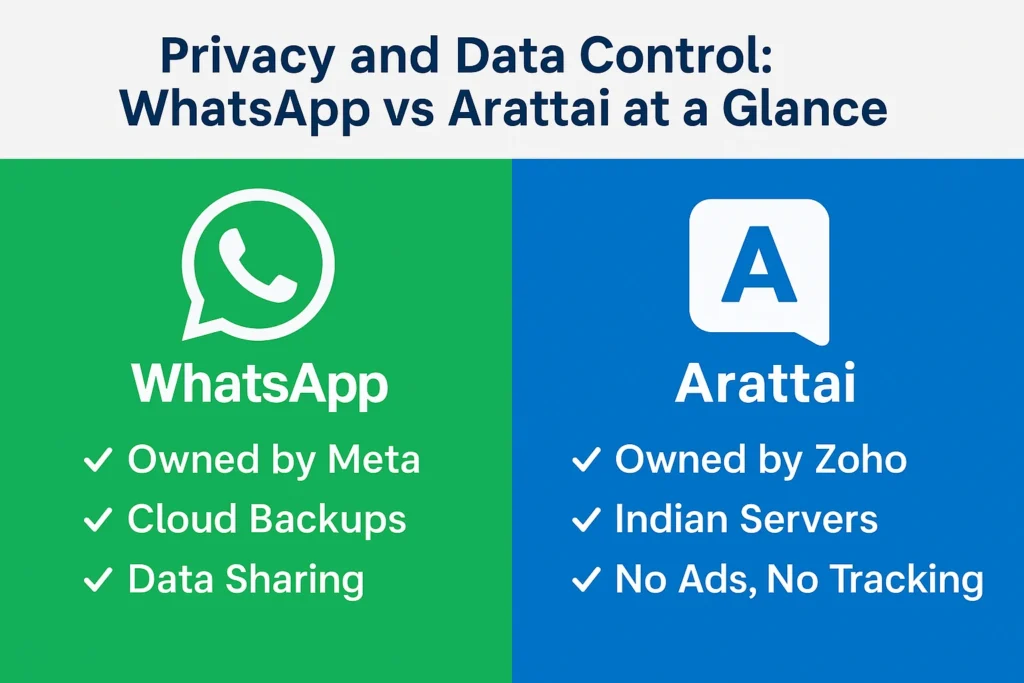
WhatsApp uses end-to-end encryption for chats, ensuring messages can’t be read by third parties. However, it collects metadata — such as device information, contact lists, and usage patterns — which can be shared across Meta’s network. This practice has raised global privacy debates.
Zoho Arattai, on the other hand, is designed around the principle of no data tracking and no advertising. All data is hosted on Zoho’s secure Indian servers, and the company follows a strict privacy policy — no sale of user data, no external analytics tools, and no third-party cookies.
For users who value data sovereignty and transparency, Arattai clearly takes the lead.
Performance and Reliability
WhatsApp offers a robust and stable experience with excellent global server performance. Its chat loading, backup synchronization, and voice/video call quality remain among the best in class.
Arattai, while newer, delivers impressive reliability on both Android and iOS. The app is lightweight, consumes less battery, and performs smoothly even on mid-range devices. Although its ecosystem is still expanding, the experience is ad-free and consistent, which enhances long-term usability.
If your priority is speed and stability, WhatsApp retains an edge due to its maturity. If you prefer efficiency and a clean user experience, Arattai delivers a focused performance.
Feature Comparison – Beyond Basic Chat
a) File Sharing and Group Chats
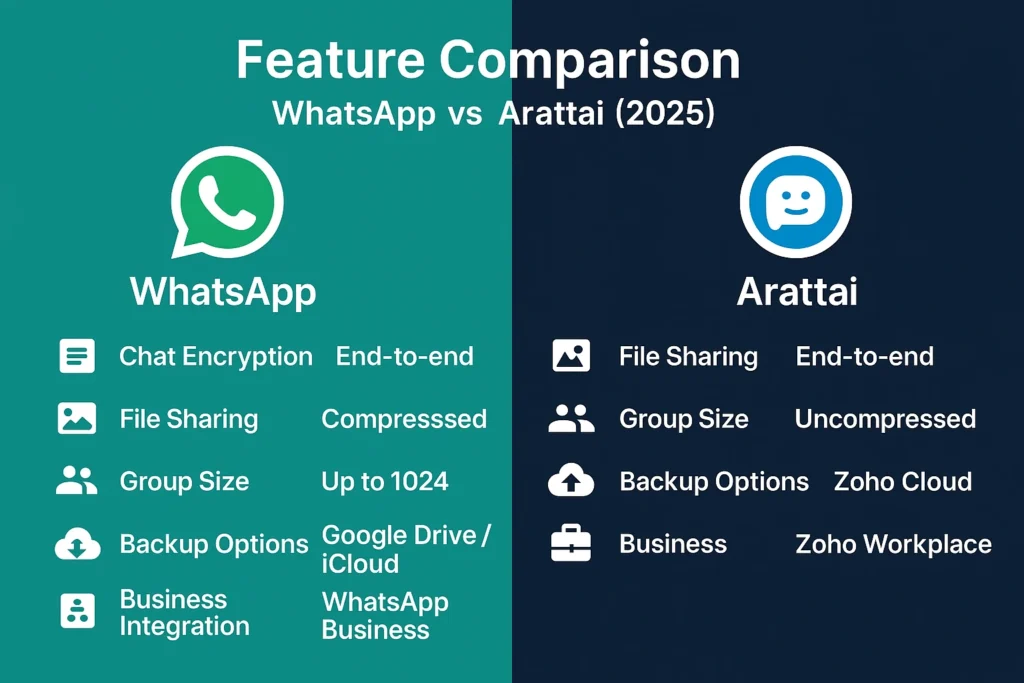
WhatsApp supports large group chats and multimedia sharing but compresses files heavily.
Arattai maintains high-quality file transfers, prioritizing data control and clarity.
b) Business and Workplace Integration
WhatsApp Business offers automated replies, catalogs, and verified profiles for small enterprises.
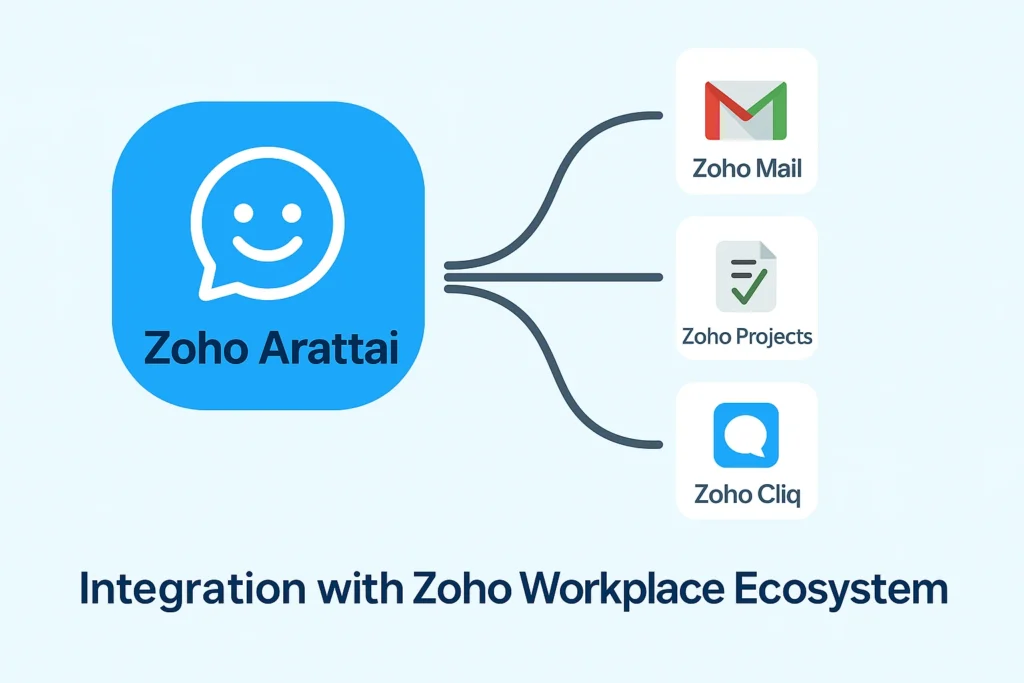
Arattai integrates natively with Zoho Workplace, Zoho Mail, and Zoho Projects, making it a strong choice for internal corporate communication.
c) Cloud Backup Options
WhatsApp uses Google Drive and iCloud, which depend on external storage providers.
Arattai’s backups stay within Zoho’s secure data centers in India, ensuring complete data localization.
Verdict:
For consumer-level convenience, WhatsApp is unmatched. For organizational communication with privacy compliance, Arattai is strategically superior.
User Experience and Interface
WhatsApp’s interface is universally recognized — minimal, familiar, and polished.
Arattai mirrors this simplicity but removes distractions such as ads, suggested links, and third-party integrations. The UI feels cleaner and focused on essential communication.
In 2025, users appreciate not just design, but attention to ethics and digital well-being. Arattai aligns closely with that expectation.
Data Ownership and Transparency
Meta’s ecosystem relies heavily on user data analytics. Although messages remain encrypted, behavioral patterns, engagement frequency, and contact metadata are part of Meta’s business intelligence model.
Zoho Corporation has consistently maintained a no-ad, no-tracking stance across all its products. Arattai extends this philosophy to messaging, giving users full ownership of their communication data.
In an era where digital privacy equals digital freedom, Arattai represents transparency — a value that’s increasingly important for businesses and individual users alike.
The Swadeshi Advantage – Made in India, Made for Trust
Arattai isn’t just another chat app. It’s part of Zoho’s broader Swadeshi SaaS initiative, which promotes data localization and technological self-reliance.
With Indian servers, Indian developers, and Indian data policies, Arattai offers users an alternative that respects both privacy and national digital ethics. For enterprises subject to Indian data compliance norms, this is a significant advantage.
Performance Verdict – Who Wins in 2025?
| Category | Winner | Reason |
|---|---|---|
| Privacy | Arattai | Local data storage, zero ads |
| Speed | Global infrastructure | |
| Business Use | Arattai | Seamless Zoho integration |
| Global Reach | Larger user base | |
| Trust & Data Control | Arattai | Transparent privacy policy |
Final Verdict:
- If you prioritize reach and ecosystem, choose WhatsApp.
- If you prioritize privacy, compliance, and ethical technology, choose Arattai.
In 2025, as privacy becomes central to user trust, Arattai stands out as the responsible alternative.
Final Thoughts
Communication tools are no longer chosen solely for convenience — they’re chosen for integrity.
WhatsApp remains the global leader, but Arattai’s rise signals a clear shift toward privacy-first communication platforms.
Both serve their purposes well: WhatsApp connects the world, while Arattai empowers users to connect securely within it.
For businesses and individuals aligned with the Made in India philosophy, Arattai is a future-proof option worth adopting.
It blends automation, simplicity, and affordability
👉 Swadeshi SaaS: The Ultimate 50+ Zoho Products Guide
👉 Top BI Tools for Nonprofits (2025)?
👉 Ulaa vs Chrome: The Privacy Browser Comparison
👉 Top Zoho Tools for Businesses in 2025
Frequently Asked Questions on WhatsApp vs Arattai

Is Arattai better than WhatsApp for privacy?
Yes. Arattai doesn’t track users, run ads, or share data with third parties. All information stays on Zoho’s Indian servers.
Can Arattai be used for business communication?
Absolutely. Arattai integrates directly with Zoho’s enterprise tools such as Workplace, Projects, and Mail.
Does Arattai offer end-to-end encryption?
Yes. Like WhatsApp, all Arattai chats are end-to-end encrypted.
Who owns Arattai?
Arattai is developed and maintained by Zoho Corporation, a globally trusted Indian SaaS company.
Is Arattai available on iOS and Android?
Yes, it’s available on both platforms along with a web version for desktop users.
What makes Arattai unique in 2025?
Its ad-free interface, zero data-sharing policy, and Indian data localization make it a strong alternative to international apps.









1 thought on “WhatsApp vs Arattai (2025): The Ultimate Comparison of Privacy, Features & Power”
Comments are closed.