- 1 Introduction
- 2 What is a Data Analyst?
- 3 What is a Data Scientist?
- 4 7 Clear Career Advantages — Data Analyst Vs Data Scientist
- 5 Similarities Between Data Analysts and Data Scientists
- 6 Which Career Path Should You Choose?
- 7 Data Analyst Vs Data Scientist Career Growth
- 8 Future Trends in 2025 and Beyond
- 9 Conclusion
- 10 FAQs for Data Analyst vs Data Scientist
Introduction
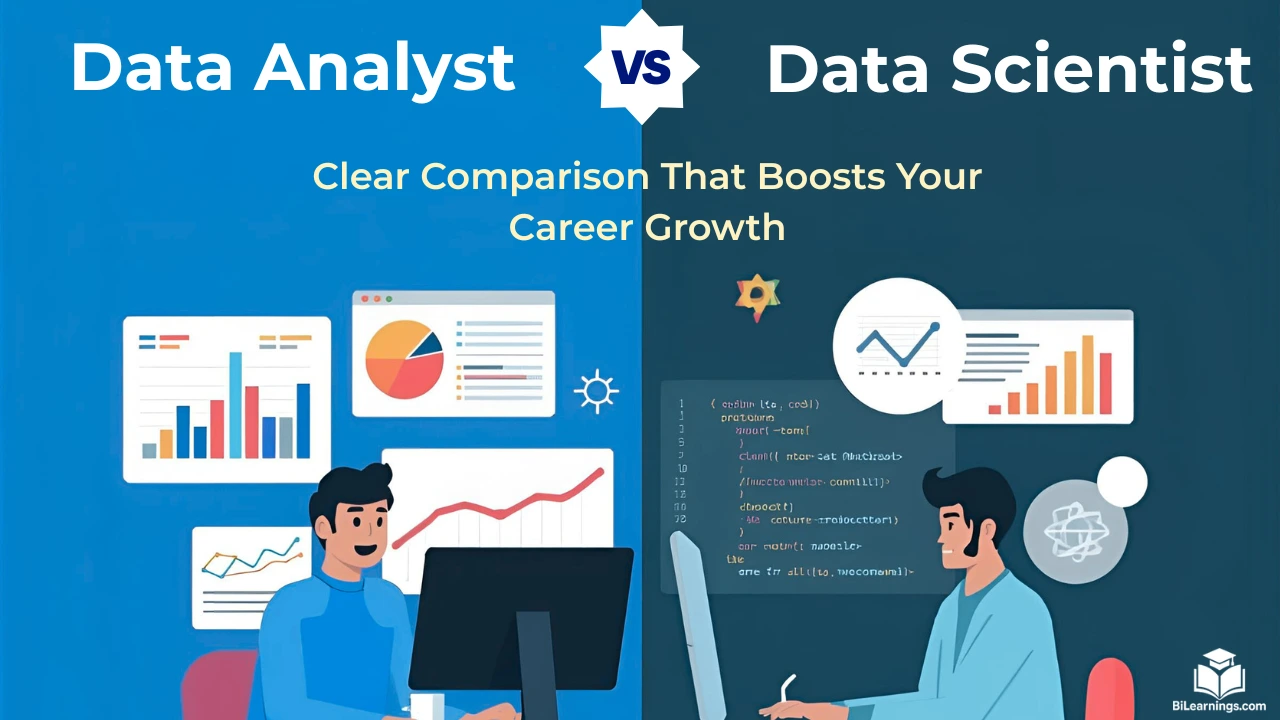
In today’s digital economy, data drives almost every business decision. But as data grows in size and complexity, so do the job roles built around it. Many professionals and students find themselves comparing data analyst vs data scientist to decide which path fits their future.
Both positions are essential in the data lifecycle, yet they serve very different purposes. Data analysts turn data into actionable insights, while data scientists design models that predict future outcomes. If you’re exploring opportunities in analytics or data science, understanding the difference between data analyst and data scientist, along with the expected salary in 2025, required skills, and long-term career growth, will help you make the right choice.

What is a Data Analyst?
Key Responsibilities
A data analyst is often called the “translator of raw data.” They pull information from databases, spreadsheets, or BI platforms and transform it into insights for business decisions. Common tasks include:
- Running SQL queries to extract datasets
- Cleaning and preparing data for analysis
- Creating dashboards and reports in tools like Power BI, Tableau, or Zoho Analytics
- Explaining insights such as “Which region had the most growth?” or “How did sales perform last quarter?”
Read More: Zoho Analytics Tutorial: [Setup, Dashboards & Best Practices]
Data Analyst Vs Data Scientist Skills (Analyst Perspective)
To succeed as an analyst, you’ll need:
- Proficiency in Excel and SQL
- Experience with BI tools and data visualization
- Strong communication and storytelling abilities
- Business acumen to interpret trends clearly
Career Growth and Salary
Data analysts often start in entry-level roles and move into senior analyst or BI manager positions. Some later transition to data science by learning programming and machine learning.
- Data Analyst vs Data Scientist salary 2025 (India): Analysts can expect ₹5–12 LPA.
- In the U.S.: Salaries range from $65,000–$85,000 annually.
Read More: What is Business Intelligence (BI) and Why Its Essential for Your Business
What is a Data Scientist?
Core Responsibilities
A data scientist takes analytics further by predicting what comes next. They answer questions like “What will sales look like next quarter?” or “Which customers are likely to churn?”
Daily tasks often include:
- Building machine learning models
- Handling structured and unstructured data
- Running experiments and A/B tests
- Deploying predictive algorithms for business outcomes
Data Analyst Vs Data Scientist Skills (Scientist Perspective)
Data scientists need more advanced technical expertise:
- Python, R, or Scala programming
- Machine learning and AI frameworks
- Knowledge of big data platforms (Hadoop, Spark, Databricks)
- Strong statistical and mathematical foundation
Career Growth and Salary
Data scientists typically start as junior scientists or ML engineers and advance to AI specialists or heads of data science.
- Data Analyst vs Data Scientist salary 2025 (India): Data scientists earn ₹10–25 LPA, with senior experts crossing ₹30 LPA.
- In the U.S.: Salaries average $95,000–$130,000 annually, with higher pay in specialized AI roles.
Read More: If you want to grow your career in Business Analytics
7 Clear Career Advantages — Data Analyst Vs Data Scientist
1. Roles & Responsibilities
- Data Analyst: Focuses on descriptive and diagnostic analytics. Answers “what happened” and “why it happened.”
- Data Scientist: Works on predictive and prescriptive analytics. Answers “what will happen” and “how can we influence it.”
2. Tools & Technologies
- Analyst: Excel, SQL, Tableau, Power BI
- Scientist: Python, R, TensorFlow, Hadoop, ML frameworks
3. Skill Requirements
- Analyst: SQL, visualization, business communication
- Scientist: Coding, statistics, ML, AI concepts
4. Data Complexity
- Analyst: Structured data (CRM, ERP, transactional tables)
- Scientist: Structured + unstructured data (social media, images, videos, logs)
5. Business vs Research Orientation
- Analyst: Business-focused, short-term reporting cycles
- Scientist: Research-focused, longer experimentation cycles
6. Salary & Career Growth
- Analysts enter the workforce faster, but with lower average salaries.
- Scientists require advanced education but see stronger long-term career growth and higher salaries.
7. Future Demand
- Analyst: Growing demand in SMEs and companies needing regular reporting.
- Scientist: Explosive demand in AI-driven industries like healthcare, fintech, and e-commerce.
Similarities Between Data Analysts and Data Scientists
Both are Problem Solvers
At their core, both roles solve business problems through data.
Overlap in Tools
Python and SQL are common to both roles, although used differently.
Importance Across Industries
From healthcare and retail to banking and startups, both analysts and scientists are critical for digital transformation.

Which Career Path Should You Choose?
Who Should Become a Data Analyst?
If you enjoy structured data, dashboards, and business reporting, becoming an analyst is a great entry point. It’s also the fastest way to start working in analytics.
Who Should Become a Data Scientist?
If you love coding, statistics, and machine learning, and want to predict the future with data, this is the better role.
Switching Between Roles
Many professionals begin as analysts and later transition into science roles by adding Python, ML, and advanced statistics to their skillset. This career switch usually takes 2–3 years of upskilling.
Data Analyst Vs Data Scientist Career Growth
When comparing data analyst vs data scientist career growth, the trade-off is between speed and potential:
- Analysts enjoy quick entry into the workforce.
- Scientists face a steeper learning curve but have higher ceilings with opportunities in AI and advanced research.
👉 The choice depends on whether you want faster entry or higher long-term rewards.
Future Trends in 2025 and Beyond
- AI-Powered Analytics: Routine analyst tasks will be automated.
- No-Code Platforms: Analysts will increasingly use drag-and-drop BI tools.
- Hybrid Roles: “Analytics Engineers” will blend analyst and scientist skill sets.
- Cloud Data Platforms: Skills in Snowflake, Databricks, and AWS ML will grow in demand.
- AI Ethics: Data scientists will focus on responsible AI and bias reduction.

Conclusion
The difference between data analyst and data scientist isn’t about one being better than the other. It’s about which role matches your strengths and ambitions. Analysts explain the past and support quick decisions, while scientists predict the future and build intelligent systems.
When it comes to data analyst vs data scientist salary 2025, scientists have the edge. But analysts provide a smoother entry into the field. In terms of skills, analysts need strong business and visualization expertise, while scientists require coding and ML knowledge.
Both paths lead to exciting opportunities. The best role is the one aligned with your passion and your plan for long-term career growth.
FAQs for Data Analyst vs Data Scientist
What is the main difference between a Data Analyst and a Data Scientist?
Who earns more: Data Analyst or Data Scientist in 2025?
Which has better career growth: Data Analyst or Data Scientist?
What skills are required for Data Analyst vs Data Scientist roles?
1. Analysts need SQL, Excel, BI tools (Zoho Analytics, Power BI, Tableau and Oracle Analytics), and strong visualization.
2. Scientists require Python, R, ML frameworks, big data tools, and advanced statistics.
Both need problem-solving, communication, and critical thinking skills.
Can a Data Analyst become a Data Scientist?
Is Data Analyst a good career in 2025?
Is Data Scientist a good career in 2025 and beyond?
Which tools are commonly used by Data Analysts and Data Scientists?
Data Scientists: Python, R, TensorFlow, PyTorch, Spark, Databricks.
Some overlap exists (like SQL and Python), but scientists focus on advanced tools for machine learning, while analysts use BI platforms for reporting.
Do Data Analysts and Data Scientists work together?
Which role should I choose: Data Analyst or Data Scientist?




2 thoughts on “Data Analyst Vs Data Scientist: Clear Comparison That Boosts Your Career Growth”
Comments are closed.