- 1 Introduction — Why This Comparison Matters
- 2 What is Data Analytics?
- 3 What is Business Analytics?
- 4 Big Data Analytics vs Business Analytics — The Core Difference
- 5 Data Science vs Data Analytics vs Business Analytics
- 6 Data Analytics vs Business Analytics: Key Differences
- 7 Salary Comparison: Data Analytics vs Business Analytics Salary (2025 Update)
- 8 Career Scope and Growth Opportunities
- 9 How to Choose the Right Career Path
- 10 FAQs — Data Analytics Vs Business Analytics
- 11 Conclusion
Introduction — Why This Comparison Matters
If you’ve ever wondered whether to build your career in data analytics or business analytics, you’re not alone. Many professionals mix up these terms because both rely on data, insights, and decision-making.
But there’s a simple truth:
Data Analytics tells you what happened.
Business Analytics tells you what to do next.
In this guide, you’ll learn the real differences between the two, how data science fits into the picture, salary comparisons, and which path might be a better career move in 2025.
What is Data Analytics?
Data Analytics focuses on processing, cleaning, and interpreting raw data to uncover patterns and trends. It’s the technical side of analytics — you dig deep into the data itself.
Example:
A data analyst at a retail company studies customer purchase patterns and finds that 70% of weekend buyers use coupons — insights like these help optimize marketing campaigns.
Common Tools:
- SQL
- Python
- Power BI
- Tableau
- Excel
Skills Needed:
Statistical analysis, data visualization, and problem-solving.
In short, data analysts are the detectives of the digital world, uncovering what happened and why.

What is Business Analytics?
Business Analytics goes one step further — it focuses on interpreting data to make better business decisions. It’s less about coding and more about understanding business outcomes.
Example:
A business analyst might use sales data to decide which product lines to expand next quarter or how to cut costs without reducing revenue.
Tools Used:
- Excel
- Zoho Analytics
- SAS
- Power BI
- Google Data Studio
Skills Needed:
Critical thinking, communication, financial analysis, and data interpretation.
Business analysts connect the dots between data and strategy — helping leaders make smarter, data-backed decisions.
Big Data Analytics vs Business Analytics — The Core Difference
Many professionals confuse Big Data Analytics with Business Analytics, but the two have different goals.
| Category | Big Data Analytics | Business Analytics |
|---|---|---|
| Focus | Handling huge, complex datasets | Driving business insights |
| Tools | Hadoop, Spark, Kafka | Power BI, Excel, Zoho Analytics |
| Goal | Extract trends and patterns | Support strategic decisions |
| Data Volume | Terabytes to Petabytes | Smaller, structured data |
In simple terms:
Big Data Analytics is about scale and processing power.
Business Analytics is about clarity and action.
Data Science vs Data Analytics vs Business Analytics
Let’s clear the confusion once and for all.
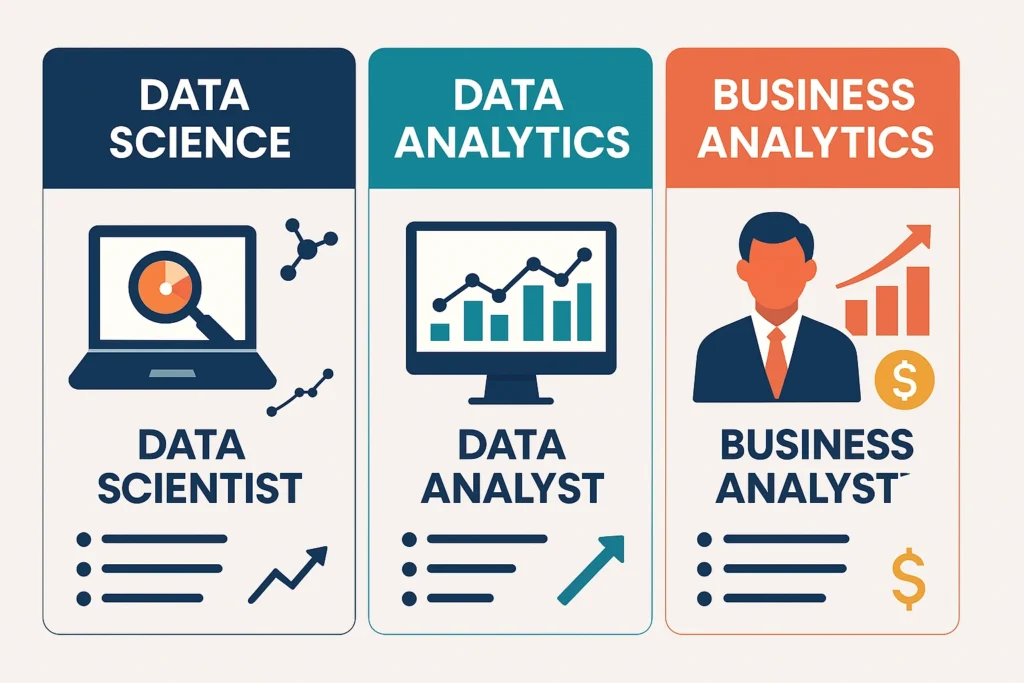
| Role | Primary Focus | Tools | Outcome |
|---|---|---|---|
| Data Science | Building predictive models using AI/ML | Python, TensorFlow | Predictive and prescriptive insights |
| Data Analytics | Analyzing structured data for trends | SQL, Tableau | Reports and dashboards |
| Business Analytics | Making business decisions from data | Excel, Zoho Analytics | Strategy and performance insights |
A data scientist builds the models,
a data analyst interprets the data,
and a business analyst turns that insight into action.
Data Analytics vs Business Analytics: Key Differences
| Aspect | Data Analytics | Business Analytics |
|---|---|---|
| Primary Goal | Understand trends | Drive decisions |
| Approach | Technical & detail-oriented | Strategic & outcome-focused |
| Tools | Python, SQL, Tableau | Excel, Zoho Analytics, Power BI |
| End Users | Data teams, engineers | Executives, managers |
| Output | Reports, visualizations | Business strategies |
To put it simply — data analytics answers “what happened?”, while business analytics answers “what should we do next?”
Salary Comparison: Data Analytics vs Business Analytics Salary (2025 Update)
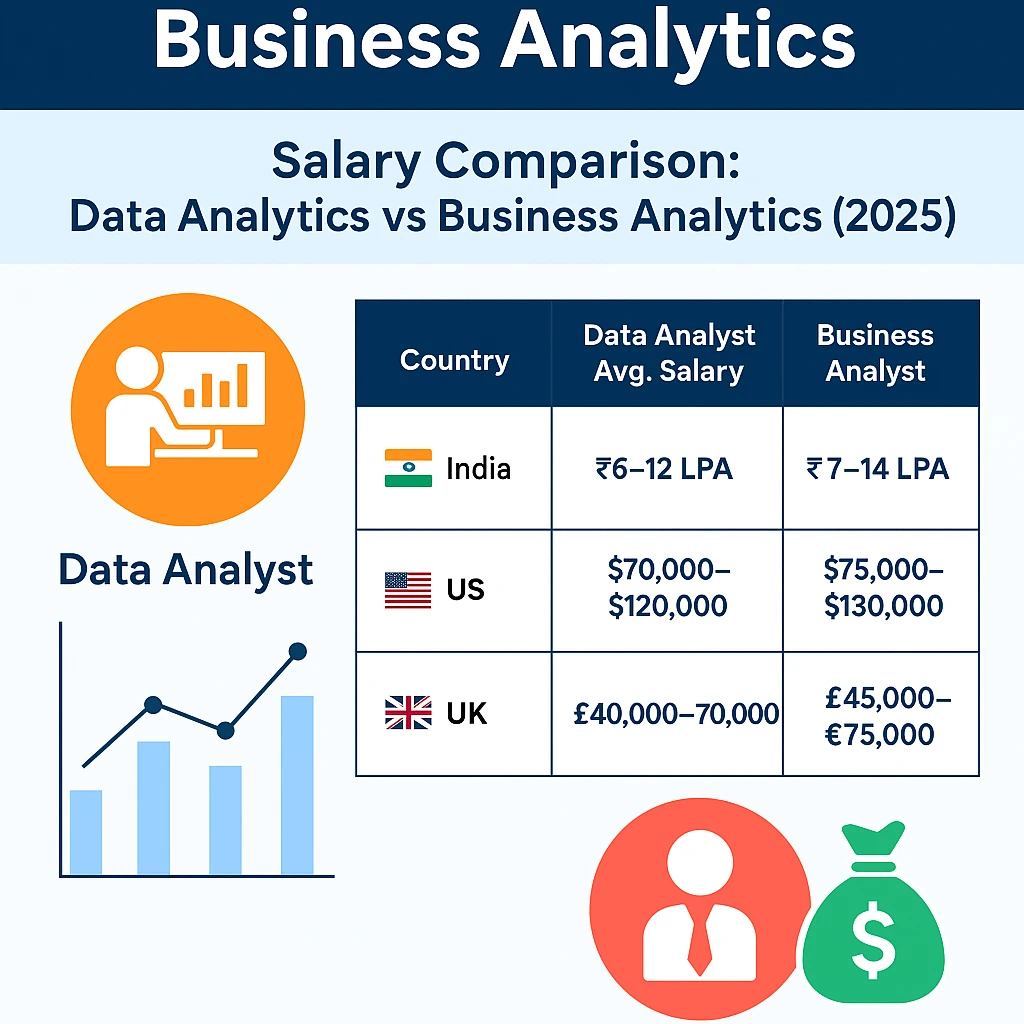
Salaries vary based on experience, skills, and industry demand. Here’s what 2025 trends suggest:
| Country | Data Analyst Avg. Salary | Business Analyst Avg. Salary |
|---|---|---|
| India | ₹6–12 LPA | ₹7–14 LPA |
| US | $70,000–$120,000 | $75,000–$130,000 |
| UK | £40,000–£70,000 | £45,000–£75,000 |
💡 Insight:
Business analysts tend to earn slightly more, as their role directly impacts revenue and strategy. However, data analysts with Python, SQL, and AI skills can surpass that easily.
Career Scope and Growth Opportunities
Both fields are booming — but in slightly different directions.
- Data Analytics: Growing fast in e-commerce, fintech, and healthcare.
- Business Analytics: Rising demand in consulting, operations, and marketing.
- Data Science: Becoming essential for automation and AI-driven decision systems.
Top Companies Hiring:
Google, Zoho, Deloitte, Accenture, Amazon, and PwC.
If you enjoy working with data sets, visualizations, and problem-solving — go for data analytics.
If you like business strategy, client discussions, and decision-making — business analytics fits better.
How to Choose the Right Career Path
- Ask yourself: Do you love coding or business strategy?
- Learn the basics: Start with Excel, SQL, and Power BI.
- Certifications worth exploring:
- Google Data Analytics Certificate
- Zoho Analytics Training
- Coursera Business Analytics Specialization
- Transition tip: Many data analysts naturally grow into business analysts as they understand business impact better.
FAQs — Data Analytics Vs Business Analytics
Which is better: data analytics or business analytics?
Is business analytics part of data analytics?
What is the salary difference between data analyst and business analyst?
Can a data analyst become a business analyst?
Which role has more demand in 2025?
How does data science fit into both roles?
Conclusion
Data analytics and business analytics are not competing careers — they’re connected steps in the same value chain.
A data analyst finds insights.
A business analyst acts on them.
In 2025 and beyond, companies need both to stay competitive.
So whether you love crunching numbers or crafting strategies, analytics is a future-proof career — it just depends on how you want to use data to create impact.
It blends automation, simplicity, and affordability
👉 Swadeshi SaaS: The Ultimate 50+ Zoho Products Guide
👉 What is Business Intelligence (BI) and Why Its Essential for Your Business in 2025?
👉 Top BI Tools for Nonprofits (2025)?
👉 Zoho Analytics vs Google Data Studio: Best BI Tool Comparison?