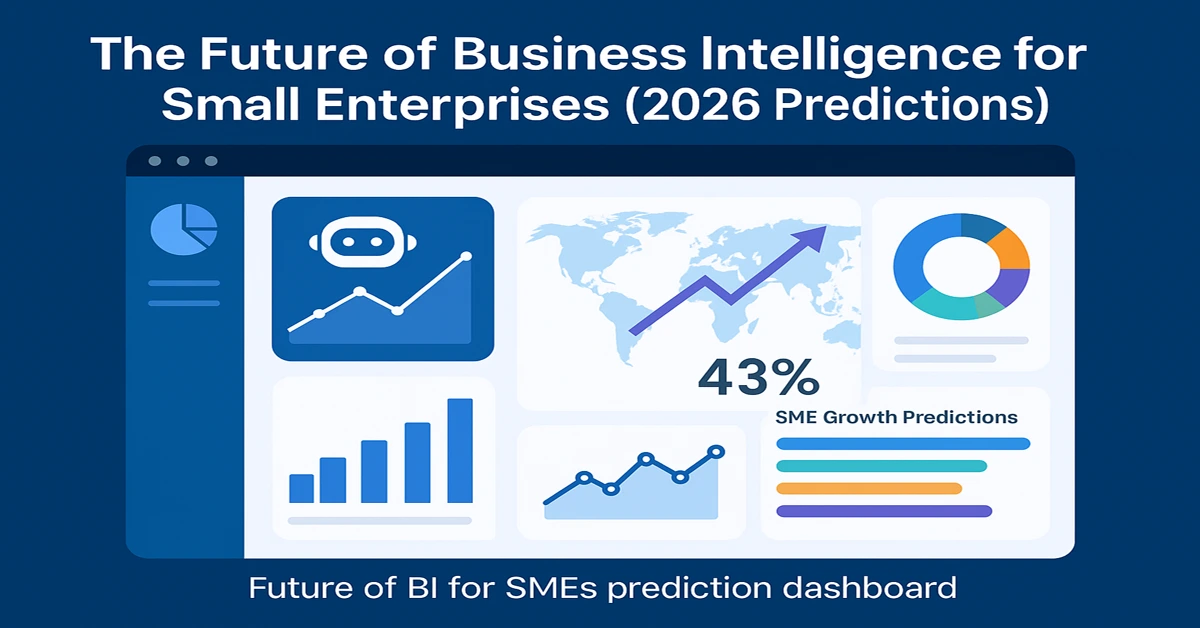
In today’s competitive world, small and medium enterprises (SMEs) can no longer rely on gut feeling alone. Decisions backed by real-time data are shaping business success stories across industries. The future of BI for SMEs is unfolding faster than ever, transforming how small enterprises plan, measure, and grow.
From affordable AI dashboards to smart integrations, BI is no longer a luxury—it’s a necessity. Let’s look at where Business Intelligence is heading and how SMEs can stay ahead in 2026.
- 1 The State of BI Adoption in SMEs (2025 Overview)
- 2 5 Key Predictions Shaping the Future of BI for SMEs in 2026
- 3 Benefits of Embracing BI Early for SMEs
- 4 How SMEs Can Prepare for the Future of BI
- 5 Top BI Tools Powering the Future of BI for SMEs
- 6 Expert Insights: What Industry Leaders Say
- 7 Final Thoughts: The Future of BI for SMEs is Now
- 8 FAQs: Future of BI for SMEs
The State of BI Adoption in SMEs (2025 Overview)
Until recently, Business Intelligence (BI) tools were considered too complex or expensive for small businesses. But things have changed. With cloud-based solutions like Zoho Analytics, Microsoft Power BI, and Odoo BI, even the smallest enterprises can now harness data with ease.
In 2025, over 63% of SMEs reported using some form of data analytics tool. The shift is clear: small businesses are realizing that understanding their data isn’t optional anymore—it’s survival.
How Cloud BI Changed the Game
Cloud BI has leveled the playing field. No more heavy IT investments, maintenance worries, or data silos. Small enterprises can access dashboards anytime, anywhere, and make quicker, smarter decisions. It’s flexibility meets affordability—a perfect match for SMEs.

5 Key Predictions Shaping the Future of BI for SMEs in 2026
Let’s look at the top five BI trends that will define the way small businesses operate in 2026.
1. AI-Driven Insights Become Affordable
Artificial Intelligence (AI) is no longer just for big enterprises. By 2026, AI-driven BI tools will become affordable and accessible to every small business owner. Imagine a bakery predicting its busiest hours or a retailer forecasting which products will trend next month—all through simple dashboards.
AI will handle complex analysis behind the scenes, allowing SMEs to focus on strategy instead of spreadsheets.
2. Real-Time Dashboards for Faster Decisions
The days of waiting for weekly or monthly reports are fading. SMEs want instant insights to react faster to market shifts. Real-time BI dashboards will become the standard, offering live updates on sales, performance, and operations.
For instance, a cafe owner can track daily revenue, most ordered items, and customer patterns—all from their smartphone in real-time.
3. Embedded BI Inside Business Apps
The future of BI for SMEs is about convenience. Business owners don’t want to juggle multiple tools—they want everything in one place. BI is now being embedded inside CRM, ERP, and accounting tools.
Solutions like Zoho Analytics, Odoo BI, and QuickBooks Insights already integrate analytics directly into their platforms. This embedded intelligence helps SMEs make decisions within the same app they use daily—whether that’s managing customers, sales, or finances.
4. Mobile BI Becomes Mainstream
The rise of mobile BI is empowering small business owners to stay informed on the go. Whether checking daily revenue or monitoring marketing campaigns, everything can now be accessed through mobile dashboards.
In 2026, expect more BI platforms to enhance their mobile capabilities—bringing powerful analytics right to your fingertips. Decision-making will literally be “in your pocket.”
5. Data Security & Compliance Take Center Stage
As SMEs handle more data, security will become a top priority. Governments are tightening privacy laws, and customers expect transparency. The future of BI for SMEs will revolve around secure data handling and compliance.
Modern BI tools are already integrating encryption, role-based access, and compliance-ready frameworks. By adopting them early, SMEs can build customer trust and avoid regulatory headaches.
Benefits of Embracing BI Early for SMEs
Embracing Business Intelligence now gives SMEs a massive head start. Early adopters can turn small data into powerful growth strategies.
- Smarter decisions – Move from guesswork to precision.
- Cost savings – Identify inefficiencies faster.
- Better customer experience – Personalize services using real insights.
- Higher agility – React quickly to market changes.
For example, a small online retailer used BI to analyze customer purchase patterns. Within three months, they optimized their stock and increased profits by 30%. That’s the power of actionable intelligence.
How SMEs Can Prepare for the Future of BI
Here’s how small businesses can start adopting BI strategically in 2025–2026:
- Start small, scale smart – Begin with a simple, affordable BI tool like Zoho Analytics or Power BI.
- Train your team – Invest in basic data literacy for employees.
- Integrate systems – Connect your CRM, accounting, and operations data.
- Review monthly metrics – Make data discussions a part of your regular team meetings.
- Ensure security – Choose BI tools that follow GDPR and local data protection standards.
The earlier you start, the more natural BI becomes in your business decisions.
Top BI Tools Powering the Future of BI for SMEs
| BI Tool | Key Feature | Ideal For |
|---|---|---|
| Zoho Analytics | Affordable cloud-based dashboards | SMEs wanting end-to-end reporting |
| Microsoft Power BI | Deep integration with Excel and Microsoft apps | Businesses already using Microsoft ecosystem |
| Odoo BI | Built-in BI within ERP suite | SMEs managing operations on Odoo |
| Google Looker Studio | Easy data visualization | Digital marketers and online retailers |
Each tool brings unique advantages, but all share a common goal—simplify analytics for SMEs.
Expert Insights: What Industry Leaders Say
According to Gartner’s 2025 BI report, “SMEs will lead the next wave of BI innovation, driven by automation, affordability, and real-time data availability.”
Industry experts predict that the biggest growth segment in BI adoption by 2026 will come from small enterprises—proving that size doesn’t limit intelligence.
Final Thoughts: The Future of BI for SMEs is Now
The future isn’t something distant—it’s already happening. The future of BI for SMEs lies in using affordable, AI-powered, and mobile-friendly tools that make data work smarter for you.
Start small, stay consistent, and let your business decisions be powered by insight—not instinct. The earlier your SME embraces BI, the stronger its foundation for 2026 and beyond.
It blends automation, simplicity, and affordability
👉 Swadeshi SaaS: The Ultimate 50+ Zoho Products Guide
👉 20 Types of Data Professionals: Your Complete Career Guide 2025
👉 Ulaa vs Chrome: The Privacy Browser Comparison
👉 What is Business Intelligence?
👉 Zoho Analytics Tutorial: Complete Tutorial for 2025 [Setup, Dashboards & Best Practices]
FAQs: Future of BI for SMEs
What is the future of BI for SMEs?
Why should small enterprises invest in BI now?
Which BI tools are best for SMEs in 2026?
How does AI impact BI for small businesses?
Is BI affordable for small companies?